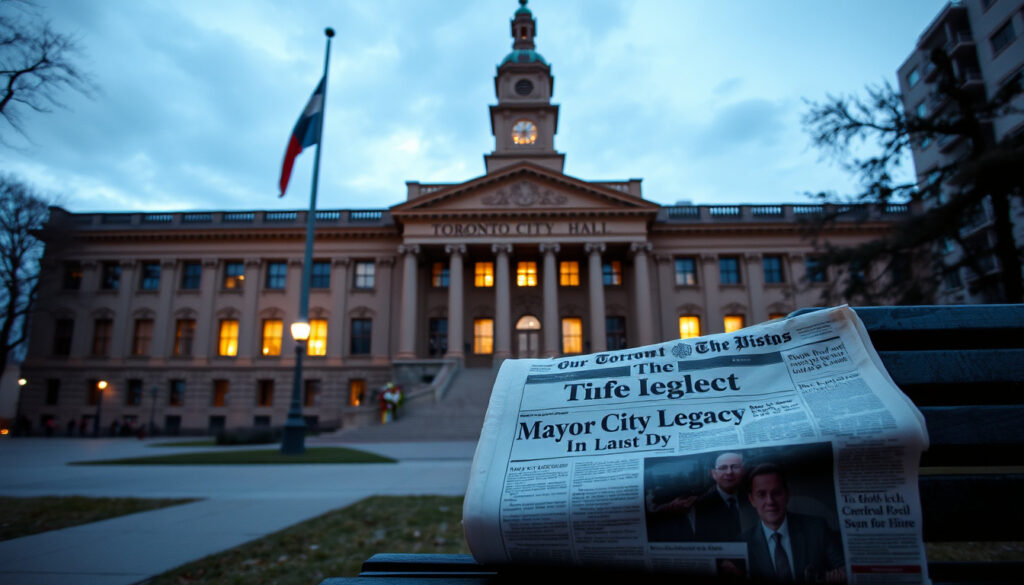
Rob Ford’s Cause of Death, Scandals, and Lasting Legacy
When Rob Ford took office as Toronto’s mayor in 2010, he promised to stop the “gravy train” at city hall. Few predicted that his term would end with a crack cocaine admission, a cancer diagnosis, and a legacy as one of Canada’s most polarizing politicians. Here’s a clear look at the man behind the headlines, the scandals, the policies, and the illness that ultimately defined his story.
Full name: Robert Bruce Ford ·
Born: May 28, 1969, Etobicoke, Ontario ·
Died: March 22, 2016, at age 46 ·
Office held: 64th Mayor of Toronto (2010–2014) ·
Cause of death: Cancer (liposarcoma) ·
Notable for: Controversial tenure, video scandal, cancer battle
Quick snapshot
- Died of liposarcoma on March 22, 2016 (CNN (international news network))
- Served as mayor of Toronto from 2010–2014 (BBC News (UK public broadcaster))
- Admitted to smoking crack cocaine in 2013 (CBC (Canadian public broadcaster))
- Brother Doug Ford became Premier of Ontario in 2018 (NPR (US public radio network))
- Exact net worth at death remains estimated (BBC News (UK public broadcaster))
- Renata Ford’s current private life is not widely reported (BBC News (UK public broadcaster))
- Allegations from police documents about threats and sexual propositions were never proven in court (BBC News (UK public broadcaster))
- Existence of a second crack video from 2014 is alleged but not independently confirmed (TIME (established news magazine))
- Cancer diagnosed in 2014, recurred in 2015, died 2016 (Live Science (popular science site))
- Crack video surfaced in 2013; admission followed (CBC (Canadian public broadcaster))
- Ford family remains active: Doug Ford is Ontario Premier (NPR (US public radio network))
- Rob Ford’s children are growing up; daughter Stephanie Ford made occasional media appearances (NPR (US public radio network))
Ford’s suburban base stood by him after the crack scandal — not despite it, but because they saw media attacks as proof he was fighting for them. His 2014 re-election run drew nearly 34% of the vote, showing his political brand survived where most politicians’ would have collapsed.
The table below condenses the essential biographical data on Ford.
| Label | Value |
|---|---|
| Full name | Robert Bruce Ford |
| Born | May 28, 1969, Etobicoke, Ontario, Canada |
| Died | March 22, 2016, Toronto, Ontario, Canada (age 46) |
| Political party | Independent (municipal), but aligned with Progressive Conservatives |
| Term as mayor | December 1, 2010 – November 30, 2014 |
| Cause of death | Liposarcoma (cancer) |
| Spouse | Renata Brejniak (m. 2000) |
| Children | 3 (Stephanie, Douglas, Michael) |
| Net worth at death | Estimated CAN$2-5 million (public sources) |
Why did Rob Ford pass away?
Timeline of his final years
Rob Ford died at age 46 on March 22, 2016 at Mount Sinai Hospital in Toronto, after a battle with pleomorphic liposarcoma, a rare and aggressive soft-tissue cancer (Live Science (popular science site)). He had been diagnosed in 2014, underwent surgery and chemotherapy, but the cancer recurred in 2015 (CNN (international news network)). His family announced his death publicly, and a funeral was held at St. James Cathedral.
The implication: Ford’s cancer diagnosis came shortly after his exit from the mayor’s office, cutting short any attempt at a political comeback at the municipal level.
What illness did Rob Ford have?
What is liposarcoma and how did it affect him?
Liposarcoma is a cancer that develops in fat cells, often in the abdomen or limbs. Ford’s type was pleomorphic, the most aggressive subtype (Live Science (popular science site)). Despite surgical removal and chemotherapy, the tumor recurred, and Ford died roughly 18 months after the initial diagnosis. His weight fluctuations and heavy public schedule likely delayed early detection.
The implication: Ford’s cancer diagnosis and recurrence defined his final years and ended any chance of a political comeback.
Why was Rob Ford controversial?
What were the main scandals during his mayoralty?
The most famous incident: a video from 2013 appeared to show Ford smoking crack cocaine. After months of denial, he admitted in a televised interview, “Yes, I have smoked crack cocaine” (CBC (Canadian public broadcaster)). He maintained he was not an addict. Earlier, a Toronto Star report said he was asked to leave a military ball because organizers thought he was intoxicated (BBC News (UK public broadcaster)). Police documents later contained allegations of threats, racist language, and sexual propositions — though Ford was never charged (BBC News (UK public broadcaster)).
Why did people not like Rob Ford?
Critics point to erratic behavior, public intoxication, conflicts with city council, and a 2012 conflict-of-interest ruling that briefly removed him from office (BBC News (UK public broadcaster)). Many in downtown Toronto viewed him as an embarrassment that hurt the city’s international reputation. Yet his supporters in the suburbs saw him as a victim of a hostile media and political establishment.
The trade-off: Ford’s blunt style that won him suburban support simultaneously alienated urban voters, journalists, and much of council — a divide that defined his entire mayoralty.
The 2013 crack video didn’t end Ford’s career — he ran for re-election in 2014 and got a third of the vote. The real political damage was personal: it accelerated his health decline and deepened the family’s us-vs-them narrative that Doug Ford later rode to the Ontario premiership.
The pattern: The scandals did not alienate his base but rather reinforced their loyalty, a dynamic that his brother later exploited.
What is Rob Ford known for?
What were his major policies as mayor?
Ford campaigned on fiscal conservatism: he cut the city budget by eliminating the vehicle registration tax and the land transfer tax, fought for a Scarborough subway extension, and froze city hiring (Britannica (encyclopedic reference)). His “Stop the Gravy Train” slogan resonated deeply in the suburbs. He also pushed to outsource garbage collection and opposed bike lanes.
How did he change Toronto politics?
Ford created “Ford Nation” — a populist, anti-elite movement that realigned Toronto’s political map. Suburban voters who felt ignored by the downtown establishment became a formidable voting bloc. His brother Doug Ford later adopted the same playbook to win the Ontario premiership in 2018 (NPR (US public radio network)). Rob Ford’s mayoralty also led to stricter ethics rules and greater scrutiny of council members, including councillors like Giorgio Mammoliti: Death, Career & Obituary.
The pattern: Ford didn’t just win an election; he changed how Toronto talked about itself, turning city politics into a culture war.
Where is Rob Ford’s wife today?
What is Rob Ford’s wife doing now?
Renata Ford (née Brejniak) married Rob in 2000 and largely stayed out of politics after his death. She resides in Toronto and keeps a very private life, occasionally attending family events (Britannica (encyclopedic reference)). She has not sought public office or media attention.
What is known about Renata Ford?
Born in Poland, Renata worked as a manager in the family business. She supported Rob during the scandals and illness but has avoided the spotlight since. Her current occupation and personal activities are not publicly documented beyond occasional real estate transactions.
Why this matters: Renata Ford’s silence contrasts sharply with the political ambitions of the Ford family, underscoring that not everyone in the clan chose the public stage.
Was Rob Ford a good mayor?
What is Rob Ford’s legacy?
Supporters credit him with lowering taxes, cutting red tape, and delivering the Scarborough subway promise. Critics highlight the scandals, lack of transparency, and damage to Toronto’s image. Polls showed deeply divided public opinion: a 2014 Forum Research poll found 39% approved of his job performance, while 56% disapproved (TIME (established news magazine)).
How is he evaluated by historians?
Academic assessments place him as a cautionary figure: a populist who got real policy wins but whose personal demons overwhelmed his administration. Some see him as a folk hero for the disenfranchised; others as a symbol of political dysfunction. The Ford family story continues through Doug Ford, who now runs Ontario — a legacy that political journalist Vassy Kapelos: Biography, Career, and Personal Life has covered extensively.
The catch: The debate over Ford’s legacy remains unresolved, reflecting deep divisions in Toronto and Ontario.
Upsides
- Cut the vehicle registration tax and land transfer tax, saving households hundreds per year
- Pushed the Scarborough subway extension through council
- Froze city hiring and reduced bureaucracy
- Outsourced garbage collection to save money
- Kept his “gravy train” promise with a balanced budget
Downsides
- Admitted using crack cocaine while in office
- Multiple public intoxication incidents and erratic behavior
- Found in conflict of interest by the courts
- Damaged Toronto’s reputation internationally
- Alienated city council and reduced trust in city hall
Timeline of Rob Ford’s life and career
Here is a chronological overview of Ford’s life and career.
| Date | Event |
|---|---|
| 1969 | Born in Etobicoke to Diane and Douglas Ford Sr. |
| 2000 | Elected to Toronto City Council for Ward 2 (Britannica (encyclopedic reference)) |
| 2010 | Elected 64th Mayor of Toronto, defeating George Smitherman (BBC News (UK public broadcaster)) |
| 2012 | Found in conflict of interest by Ontario Divisional Court; later reinstated on appeal (BBC News (UK public broadcaster)) |
| 2013 | Admitted to smoking crack cocaine after video surfaced (CBC (Canadian public broadcaster)) |
| 2014 | Diagnosed with liposarcoma; entered treatment; did not seek re-election (Live Science (popular science site)) |
| 2015 | Cancer recurred; underwent further surgery (CNN (international news network)) |
| March 22, 2016 | Died from cancer at Mount Sinai Hospital, Toronto (CNN (international news network)) |
The catch: Ford’s timeline shows a condensed arc — from political peak to personal collapse in just six years. The speed left little room for redemption narratives, but also cemented his status as a uniquely flash-in-the-pan figure.
What we know and what’s unclear
Confirmed facts
- Rob Ford died of liposarcoma on March 22, 2016 (CNN)
- He served as mayor of Toronto from 2010–2014 (BBC)
- He admitted to using crack cocaine in 2013 (CBC)
- He was married to Renata Ford until his death (Britannica)
- His brother Doug Ford became Premier of Ontario in 2018 (NPR)
What’s unclear
- Precise net worth at death is not publicly confirmed beyond estimates (BBC)
- Renata Ford’s current personal life and private activities are not widely reported
- Allegations from police documents about threats and sexual propositions were never proven in court (BBC)
- Existence of a second crack video from 2014 is alleged but not independently confirmed (TIME)
- Whether Ford’s drinking and drug use contributed directly to his cancer is unknown — no medical consensus
The bottom line: While many facts are confirmed, key details about Ford’s personal life and unproven allegations remain ambiguous.
“Yes, I have smoked crack cocaine.”
— Rob Ford, 2013 interview with CBC (Canadian public broadcaster)
“Rob Ford passed away peacefully this morning.”
— Doug Ford, family statement, March 22, 2016 (CNN (international news network))
“He was a colourful, controversial figure who loved this city.”
— John Tory, then-Mayor of Toronto, 2016 (BBC News (UK public broadcaster))
For Toronto voters who lived through the Ford years, the choice is still stark: embrace the man who cut taxes and spoke their language, or remember the scandals that embarrassed the city. Either way, the Ford legacy is now Ontario’s reality — and the province is living with the consequences of that divided judgment.
abc30.com, theweek.com, britannica.com, time.com, en.wikipedia.org, youtube.com
Toronto politics also lost former Rob Ford ally Giorgio Mammoliti, a councillor who worked alongside Ford on several municipal initiatives.
Frequently asked questions
What is Rob Ford’s cause of death?
Rob Ford died of pleomorphic liposarcoma, a rare and aggressive soft-tissue cancer, on March 22, 2016 (Live Science).
How old was Rob Ford when he died?
He was 46 years old (BBC News).
Who is Rob Ford’s wife?
Renata Ford (née Brejniak). They married in 2000 and had three children (Britannica).
Does Rob Ford have children?
Yes, three: Stephanie, Douglas, and Michael (Britannica).
What was Rob Ford’s net worth?
Estimated at CAN$2-5 million at the time of his death, according to public sources and real estate records (BBC News).
Is Rob Ford related to Doug Ford?
Yes, Doug Ford is Rob Ford’s younger brother. Doug later became Premier of Ontario in 2018 (NPR).
What was the Rob Ford crack video scandal?
In 2013, a video appeared to show Ford smoking crack cocaine. After months of denial, he admitted it. No criminal charges were filed (CBC).
More related posts
 Lakers vs Toronto Raptors Match Player Stats – Full 2024 Game Breakdown
 Jo Koy: Net Worth, Tour 2026, Ex-Wife, Son & Career
 Queen Elizabeth II: Answers to the Most Searched Questions
 Free Printable Crossword Puzzles – Best Daily PDFs and Sources
 Reid Wiseman: Artemis II Commander and Single Dad
 High Schools in Ireland: Terminology & Top Schools
 Goya’s Saturn Devouring His Son: Meaning, Analysis & History
 Blake Lively: Accusations, Relationships, and Family Life
